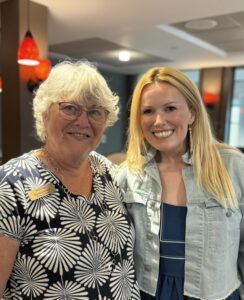
Last week, I attended a networking event at Nichols Village in Groveland, Massachusetts. It was one of those afternoons that reminds you why relationships matter, not just for business, but for life. I had the chance to reconnect with longtime colleagues in the elder care community, meet new faces, and catch up with my friend Brenda Burkholder, someone I’ve respected for many years.
During our conversation, Brenda shared a concept from The Connection Cure by Dr. Julia Hotz that immediately resonated with me: social prescribing.
At its core is a beautifully simple idea.
Instead of asking older adults, “What’s the matter with you?” what if we first asked, “What matters to you?”
That subtle shift can completely change the conversation.
Instead of focusing only on symptoms, we begin talking about purpose, relationships, hobbies, community, and the things that make life meaningful. Sometimes what someone needs isn’t another prescription. Sometimes it’s a reason to get out of the house on a Tuesday morning.
The Hidden Health Risk of Senior Loneliness We Don’t Talk About Enough
Senior loneliness isn’t simply an emotional issue, it’s increasingly recognized as a public health concern.
According to the National Institute on Aging:
“About one in four adults age 65 and older are socially isolated, and loneliness and social isolation are associated with increased risks of dementia, heart disease, stroke, depression, anxiety, and premature death.”
That’s a startling statistic, but it also makes sense.
As we age, our social circles often become smaller. Retirement ends daily interactions with coworkers. Children grow up and move away. Friends relocate or pass away. Health concerns or transportation challenges can make getting out more difficult.
Before long, isolation can quietly become part of everyday life.
What Is Social Prescribing?
In The Connection Cure, Dr. Julia Hotz explores the growing movement of social prescribing, the idea that health isn’t influenced solely by medicine, but also by meaningful relationships, movement, creativity, and community.
Rather than immediately reaching for another prescription, healthcare providers may encourage people to reconnect with activities and relationships that give life purpose.
It’s not a replacement for medical care. It’s recognizing that connection is part of healthy aging.
Start With a Different Question
Whether you’re thinking about yourself, an aging parent, or another loved one, try asking questions that go beyond physical health.
Instead of asking only about appointments or medications, consider asking:
When was the last time you laughed with someone?
What activity makes you lose track of time?
Who do you regularly spend time with?
Is there somewhere you feel like you belong?
If you had one more social activity every week, what would it be?
What matters most to you right now?
The answers may reveal needs that have nothing to do with healthcare—and everything to do with quality of life.
Don’t Overlook Your Local Senior Center
If there’s one resource I’d encourage older adults and caregivers to rediscover, it’s the local senior center.
Many people still picture senior centers as places to play cribbage, and yes, you’ll probably still find a card game if that’s your thing. But today’s senior centers are so much more. They’re one of the easiest and most affordable ways to build friendships, stay active, and remain connected to your community.
If you’ve never visited yours, or it’s been years since you have, you may be pleasantly surprised.
I wrote another blog highlighting why today’s senior centers are one of the best-kept secrets in healthy aging. If you’re curious what your local center might offer, I encourage you to give it a read.
Why This Matters in Retirement Planning
One of my favorite conversations with clients happens when someone who’s nearing retirement asks,
“Can I afford to volunteer?”
At first glance, it sounds like a financial question. But what they’re really asking is, “Can I afford to spend my time doing something that matters to me?”
After decades of measuring success by a paycheck, retirement gives us the opportunity to measure it differently. Instead of asking how to make every hour profitable, we get to ask how to make every hour purposeful.
Sometimes that purpose is volunteering at a local nonprofit or mentoring someone younger. Sometimes it’s serving on a board, becoming more involved at church, or helping at the food pantry.
And sometimes it’s something even more personal. It’s being the grandparent who can pick up the grandchildren from school, watch them during school vacations, or simply have the freedom to say “yes” when family needs you.
Those conversations naturally lead into another topic we spend a lot of time discussing at Powwow: elder care planning. Because sometimes it’s not only finding time from retiring, but it’s finding time from not caring for the big empty house. Houses can be a big drag on our time and resources. Being open to the idea of rightsizing to a more manageable setting, even if it may be independent or assisted living, can really allow for spending our time and energy on what brings joy and purpose.
When we understand what truly matters to someone, the relationships they value, the people they want to spend time with, and how they envision helping family, we’re also uncovering their preferences for aging.
Who would they want nearby if they needed help someday?
- Would they rather age in place if possible?
- Would they prefer a vibrant retirement community because staying socially connected is important to them?
- Would they rather spend their time caring for grandchildren than working another year for a larger nest egg?
Those answers influence financial planning just as much as investment returns or tax strategies.
When I help someone determine they can afford to retire, what we’re really discovering is something much more meaningful:
They’ve earned the freedom to spend their time on what matters most.
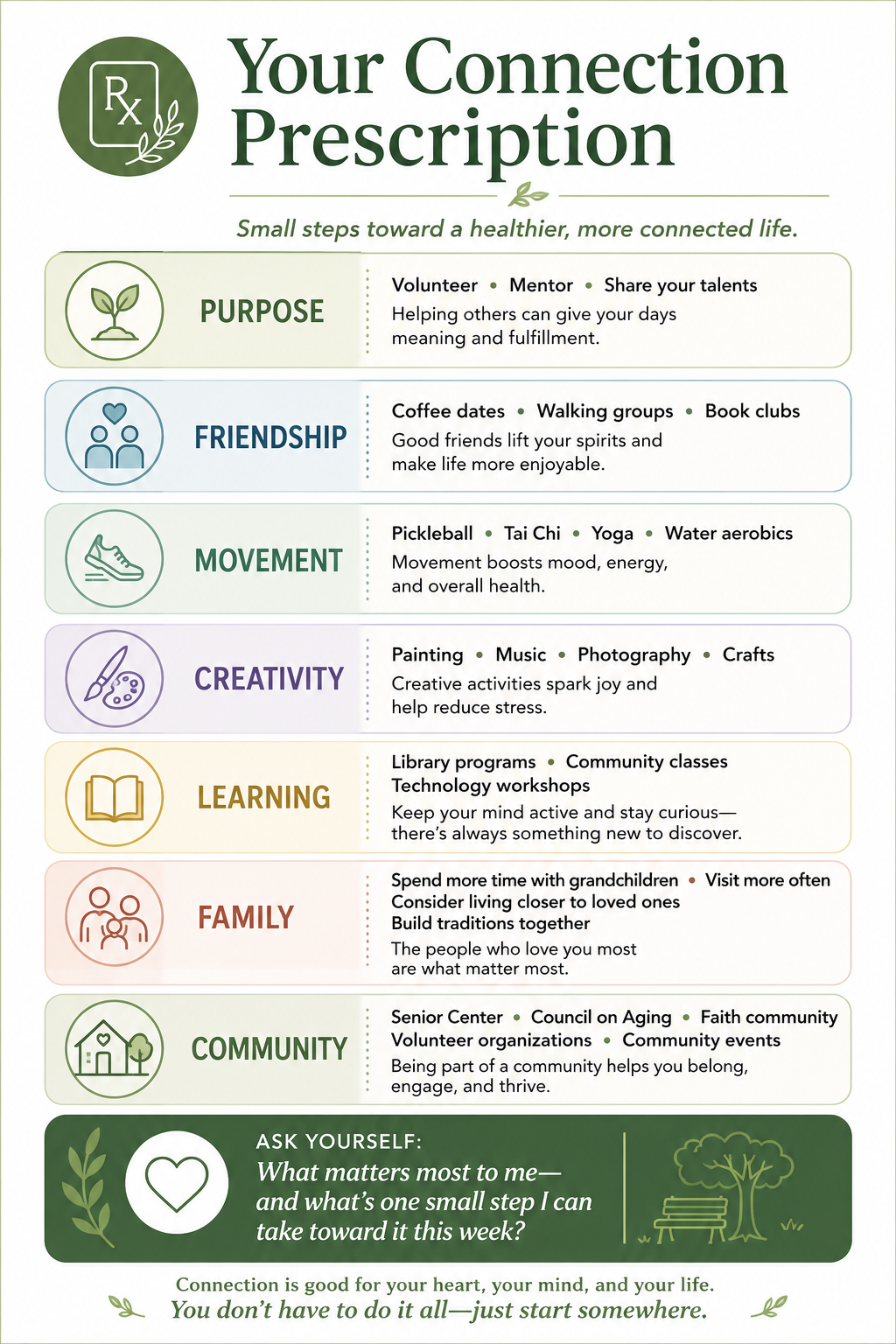
This Week’s Connection Prescription
This week, try one small step toward greater connection.
☐ Call a friend.
☐ Invite someone to coffee.
☐ Visit your local senior center.
☐ Attend one community activity.
☐ Ask yourself, or someone you love, “What matters to you?”
You might be surprised where the conversation leads